Fit, Decoded: An AI Virtual Trial Room
Client
InElemnt
Year
2025-2026
Online fashion shopping suffers from a fundamental trust gap: shoppers can't tell how a garment will actually fit their body, leading to hesitant purchases, cart abandonment, and return rates that erode retailer margins. Static size charts and generic models fail to account for individual body shape, so customers either over-order sizes to compare at home or avoid purchasing altogether.
This project set out to close that gap with a virtual trial room powered by fit intelligence, letting users generate a personalized avatar, try on garments digitally, and receive size guidance grounded in their actual body measurements rather than generic charts.
Scope of Work


Avatar Generation
The Challenge
Letting shoppers upload a photo to generate their avatar raised privacy concerns, and the ~30 second render time was long enough to lose momentum before reaching try-on.
The Solution
We addressed privacy directly with a visible "your photos are safe" message at the upload point, paired with a curated array of preset model faces and bodies for shoppers who'd rather skip upload entirely. For wait time, shoppers aren't left staring at a loader, they can shop immediately on a ghost render, a placeholder avatar that holds their place while the real digital twin finishes generating in the background.
Why this works
Trust is stated, not assumed — the privacy message removes hesitation at the exact moment it would occur
Choice removes friction — presets give privacy-conscious shoppers a zero-upload path
Dead time becomes shopping time — the ghost render turns a 30-second wait into uninterrupted browsing instead of a stall
Size Bar Placement
The Challenge
Most fashion apps place the size selector at the bottom, a pure cart input with no visual weight beyond pick-and-add.
The Solution
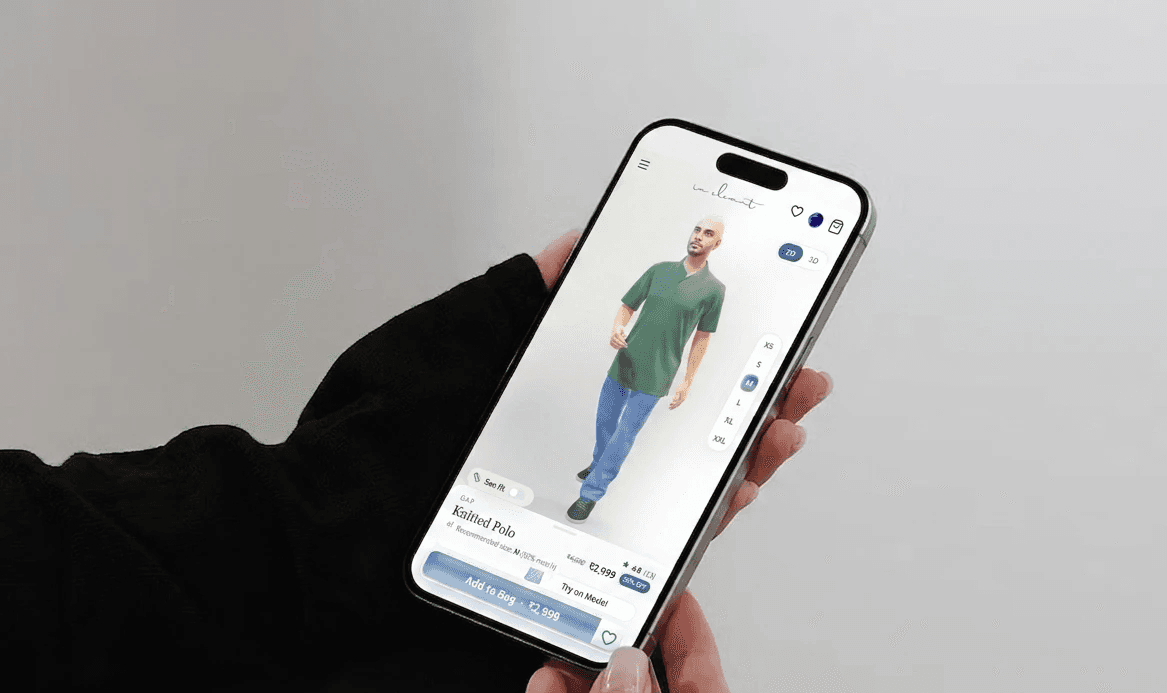
I moved the size bar next to the avatar instead, turning it into an invitation. Tapping a size instantly shows how it looks on the body, so the size bar becomes something to play with, not just fill out.
Why this works
Turns selection into exploration — proximity to the avatar makes it about seeing, not just choosing
Leads with the differentiator — visual fit-by-size is the app's core value, so it shouldn't be buried at the bottom
Builds confidence before commitment — shoppers compare sizes and watch the fit change before adding to cart


The Menu That Tries Itself On
Browsing a menu and trying items on are usually separate steps, scroll, tap, then leave to check the avatar. So the menu itself opens as a popup with the avatar inside it, items appear live on the digital twin the moment they're tapped. Style options sit alongside it for mixing and styling different pieces together, with outfit pairings other shoppers bought together surfaced right there.

Fit Intelligence
Fit Intelligence reads the body as a heat map instead of a single size label, flagging exactly where a garment fits comfortably (green) and where it strains (red/orange): chest compression, back yoke tension, waist elasticity, knee stress. It even factors in fabric composition, since stretch behavior shifts with elastane ratio.
The core idea: fit isn't one number, it's a map of trade-offs across the body. For inelemnt, this turns a fit guess into a fit prediction, showing users precisely where a size will feel right before they buy.


